


Thorens 403DD
This item cannot be purchased online; email us for a fast response and to purchase.
30-day return policy


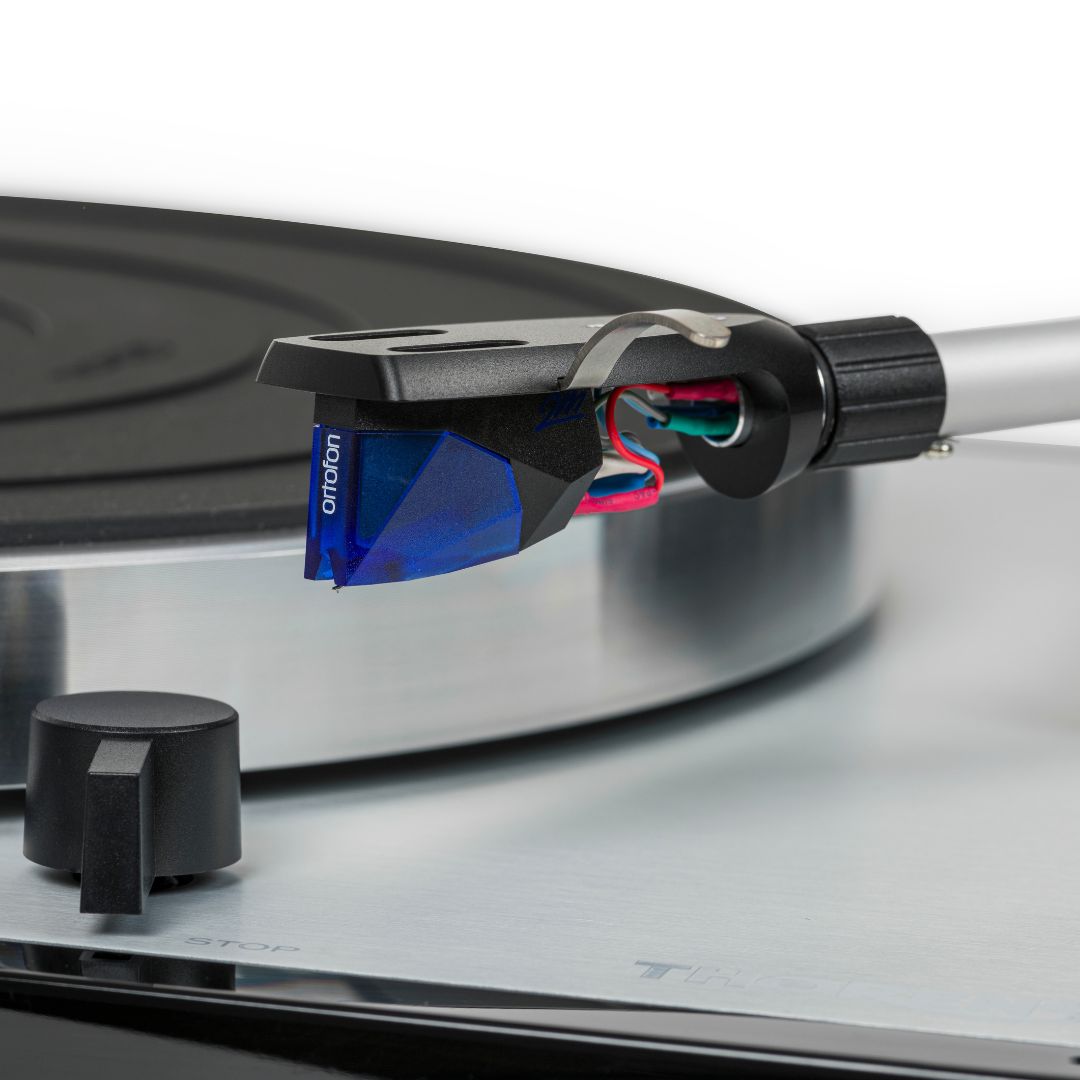


The Thorens TD 403 DD combines the convenience of a plug-and-play turntable with audiophile engineering. Its precise and smooth-running direct drive, the massive 1.4 kg, 22 mm thick die-cast aluminium platter and the high-quality TP 150 tonearm provide the foundation for detailed and musical vinyl reproduction.
Direct Drive, and Why We Stopped Apologizing For It
Somewhere in the 1980s it was decided that belt drive was for serious listeners and direct drive was for DJs. We've spent about a decade arguing with that on the sales floor, usually while standing next to a serviced Technics or Pioneer that sounds better than it has any business sounding.
The TD 403 DD is Thorens' most capable direct-drive turntable, and it makes the case better than we can. The motor is the same quiet, well-sorted drive Thorens uses in the TD 402 DD, and it does what direct drive has always done well: comes up to speed immediately, holds it without argument, and asks nothing of you afterward. No belt to replace in four years. No belt to slowly stretch in year three while you fail to notice your records are running a hair flat.
If you grew up with a direct-drive deck and you've been told you were supposed to graduate to belt drive, this is the turntable that says you weren't.
The Platter Is Where the 403 Pulls Away From the 402
On paper the two decks share a motor. On the shelf they're not close.
The TD 403 DD gets a die-cast aluminum platter, 22mm thick and 1.4 kg — a substantial step up from what the 402 carries. That mass is doing real work. Rotational inertia is what resists the tiny speed fluctuations stylus drag introduces as the groove content gets denser, so the platter and the motor controller are handling the same problem from two directions: mechanical inertia smoothing the fast stuff, electronic control catching the rest.
You can hear the difference between these two decks, and most of it is here.

The 403 arrives with an Ortofon 2M Blue already fitted and set up at the factory. That's a genuine cartridge, not a placeholder — a step up from the Audio-Technica VM95 on the 402, and it's where the 2M line starts using a nude diamond.
Nude means the diamond is a solid piece bonded straight to the cantilever rather than a chip glued to a metal shank. Less mass at the tip, so the stylus tracks groove detail instead of lagging a fraction behind it. The elliptical profile reads the groove wall more accurately than the conical stylus you'll find on cheaper decks, particularly on inner tracks where the groove gets crowded and lesser styli start to smear.
Output is 5.5mV, which is comfortable for any MM phono input — you won't be hunting for gain.

Thorens TP 150 tonearm
This is the part that surprises people, and it's the reason we stock the 403 instead of stopping at the 402.
The TP 150 is the same tonearm Thorens fits to the TD 1500, a deck that costs roughly twice as much. It's a nine-inch J-shaped arm with 14 grams of effective mass, built on the design principles of the TP 124 from Thorens' flagship TD 124 DD. Fourteen grams is the useful middle of the range — it'll partner with most moving magnets and a great many moving coils without the resonance mismatch you get at either extreme.
It adjusts where it matters. VTA and azimuth are both available to you. Set the arm height so it sits level with whatever cartridge you've mounted, then square the stylus in the groove for proper channel separation. Most turntables at this price give you tracking force and a shrug.
The headshell detaches, SME standard. Which means you can keep a second headshell with a different cartridge already mounted and aligned, and swap between them in under a minute. A mono cartridge for your original jazz pressings, an MC for everything else. Once you've aligned each one, you never do it again.
Anti-skate runs over a ruby bearing. A sliding weight in the arm base pulls a nylon thread across a ruby. The ruby is there because friction at that pivot is the whole problem — an anti-skate mechanism that binds delivers uneven force across the side, which does more harm than leaving it alone. This design stays smooth from lead-in to run-out and holds its setting.
No Phono Preamp, No Automation — Deliberately
The TD 402 DD has a built-in phono stage and auto start/stop. The 403 has neither, and that's the point of it.
Thorens calls this the puristic approach. Practically it means the signal path from your cartridge to your phono stage has nothing extra in it, and the shortest possible route out of the chassis. You'll need an outboard phono preamp or an integrated amp with a phono input — and if you don't have one, come talk to us, because that's a real decision and a cheap phono stage will undo the money you just spent.
It's fully manual. No auto-return, no auto-stop, no end-of-side lift. When the side finishes, you get up. Some people want that; some people absolutely do not, and if you're the second kind, we'd rather point you at the 402 or the 404 DD than sell you the wrong deck.
Two levers on the top plate handle everything: start/stop on the right, 33/45 on the left. The main power switch lives on the back panel — worth knowing, because if the top levers seem dead, that's why.
What to Expect From It
Direct drive tends to have a particular character, and the 403 has it: mid-bass with real weight and a sense of immediacy, notes arriving with their leading edge intact. Reviewers consistently describe it as strong on rock, pop, and jazz — the stuff that wants drive and density more than delicacy.
The honest limit is the cartridge, not the turntable. A moving magnet gives you a full, present midrange and slightly less air up top than a good MC. On solo piano or massed strings you'll eventually want more shimmer in the high harmonics. That's an upgrade this deck is ready for, which is the whole argument for the SME headshell.
In the Box
Plug-in 12V power supply, acrylic dust cover, RCA cable, and Thorens rubber mat. 33⅓ and 45 RPM.
And a tip most people never hear: take the dust cover off before you play a record. Leaving it down changes the sound. It's there to keep dust off the deck while it's parked, not to be closed while it's running. The cover and hinges lift straight off the back.
SPECIFICATIONS
Function: Manual
Drive system: Direct drive
Motor: DC motor 24V
Speeds: 33-1/3, 45 rpm.
Speed: Select electronical
Platter: 12" / 1,4 kg Die-cast aluminum platter with 22 mm height
Tonearm: Thorens TP 150 with SME headshell
Cartridge: Ortofon 2M Blue with nude elliptical stylus
Phono preamplifier: No
Anti-Skating: Anti-skating weight, which is adjusted on a nylon thread guided over a ruby bearing
Shut off: No
Power supply: External power supply 24V DC
Dimensions: 420 x 150 x 360 mm (W x H x D)
Weight: 7.2 kg
Finish: Black high gloss, walnut high gloss, oak matt, top board aluminum
Scope of delivery: Power supply, acrylic dust cover, RCA cable
