


Thorens 404DD Turntable
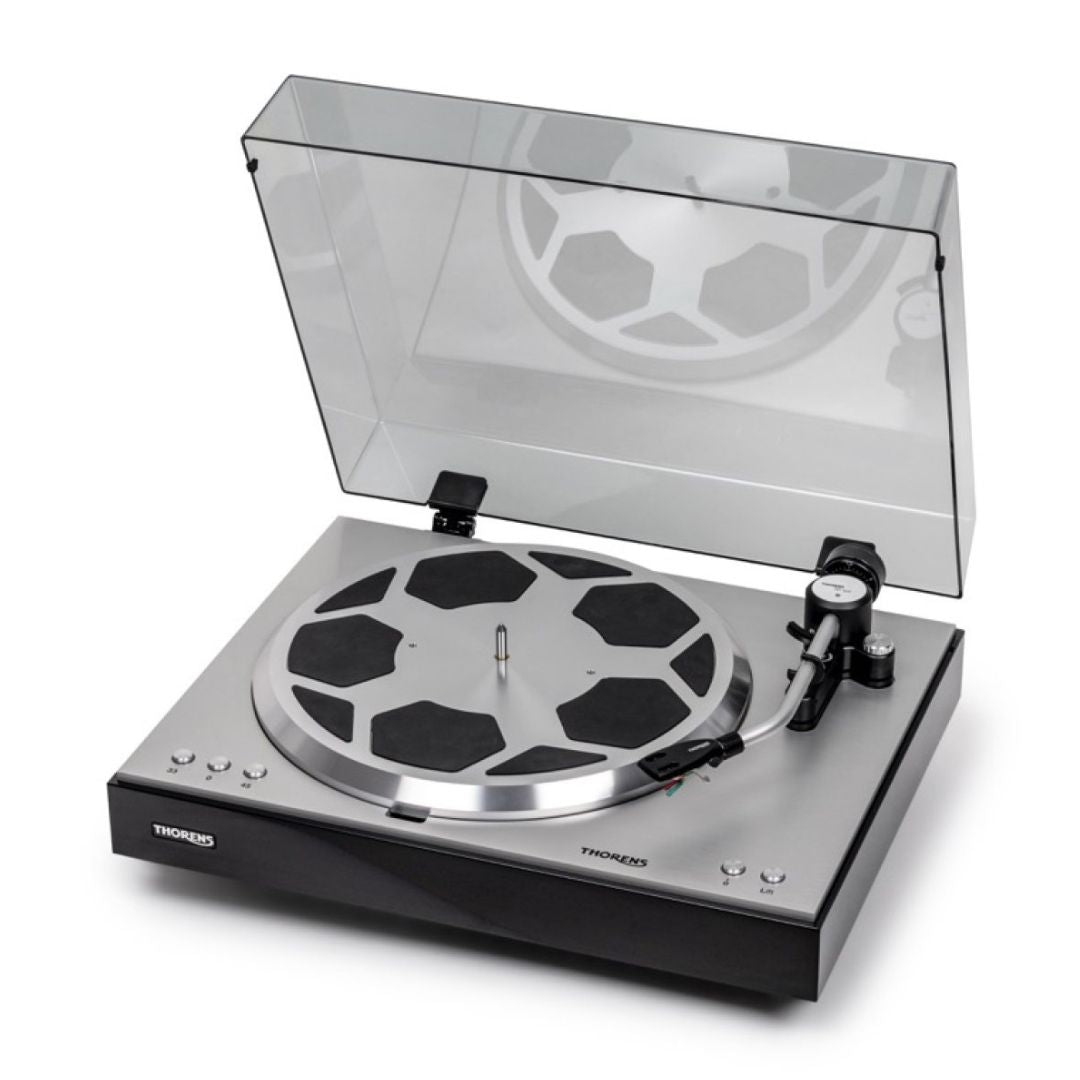
With the new TD 404 DD, Thorens once again sets standards in high-end turntable construction. This new model combines iconic elements of the audiophile classic TD 124 DD with the latest technology and elegant design—a true statement for demanding music lovers.
This item cannot be purchased online; email us for a fast response and to purchase.
30-day return policy



Features
Powerful direct-drive motor
TP 160 tonearm
Electronic tonearm lift
New platter design
Integrated stroboscope with pitch control
Height-adjustable & spring-loaded feet
RCA & XLR outputs
High-end technology in detail
Another highlight is the revised electronic tonearm lift (e-Lift) with auto-stop function, which not only offers ease of use but also reduces wear on the stylus and record.
The new platter design impresses with its modern design language and its sophisticated resonance damping - complemented by an integrated stroboscope with pitch control, which allows precise fine tuning of the speed.
Three height-adjustable, spring-loaded feet ensure a stable installation and effective decoupling, while the solid frame in sandwich construction - including a 5 mm thick aluminium top plate - gives the turntable an exceptionally low resonance and visual presence.

Connectivity for the highest demands
At the rear, the TD 404 DD is easy to connect: in addition to high-quality gold-plated RCA outputs, balanced XLR connections are also available - ideal for connecting to sophisticated hi-fi chains. The scope of delivery also includes a removable cover.
The TPN 124 linear power supply unit is available as an option, which unlocks the full sonic potential of the TD 404 DD thanks to its particularly clean power supply.
The Motor Is the Reason to Buy This Turntable
Thorens put the TD 124 DD's direct-drive motor in the TD 404 DD, and if you only remember one thing about this deck, make it that one.
Direct drive means the platter sits on the motor shaft. No belt to stretch, no pulley to slip, no rubber loop quietly aging in your living room for eight years until you finally notice the pitch is off. Speed comes from electronic control of the motor itself, which either works or it doesn't — and Thorens has spent a lot of money making sure this one works.
The published figures are 0.035% DIN and 0.007% WRMS. Numbers that low mean sustained notes sit still. Piano decays don't waver, held strings don't shimmer at the edges, and busy passages keep their internal timing instead of smearing. Electronic pitch control and a stroboscope let you verify all of it yourself rather than taking our word for it.
Three speeds, all selected electronically: 33⅓, 45, and 78.
The Platter Is Doing More Than Spinning
Every platter spins. The interesting question is what happens to the energy your stylus dumps into the record while it does.
The TD 404 DD's platter was designed for this deck specifically, with a resonance damping system and a copper layer reinforcing the aluminum. The copper does two jobs — it improves the acoustic coupling between platter and record, and it puts damping mass right at the surface the record touches, which is where it does the most good. Energy that gets absorbed there never comes back up through the vinyl to color what you're hearing.
Step down to the TD 403 DD and you get a standard die-cast aluminum platter. It's a good platter. This one was engineered further, in both structure and material.
The perimeter carries stroboscope markings, so checking your speed is a glance rather than a project.
e-Lift: The Feature Audiophiles Pretend Not to Want
Here's an unglamorous truth. Most stylus wear doesn't come from playing records. It comes from the record ending while you're in the kitchen.
The TD 404 DD carries a revised version of the e-Lift system from the TD 1601. When the stylus reaches the run-out groove, the deck notices, raises the arm clear of the record, and shuts the motor down. Nothing touches the tonearm but the mechanism. You don't have to be in the room, and you don't have to sprint.
Two things that buys you: your stylus stops grinding through dead wax for however long it takes you to come back, and your motor stops running for no reason. Both add up over a decade of ownership.
The lift is motorized rather than lever-operated, which also means every cue lands the same way. If you've ever fumbled a manual cue onto track four, you already understand the appeal.
Worth knowing: this is auto-stop, not auto-return. The arm lifts and the platter stops — it doesn't park itself back on the rest. Come see one and we'll show you exactly what it does.
The Part Nobody Photographs
Plinths don't sell turntables. They should.
The TD 404 DD uses sandwich construction — layered materials picked for how they behave together, not individually — with a 5mm aluminum plate on top. The result is stiff and acoustically dead, which matters because every vibration that reaches the plinth has a direct route to your tonearm, and your cartridge cannot tell the difference between a vibration from the groove and a vibration from your floor. It amplifies both.
Underneath are three height-adjustable feet with spring damping. They handle two separate problems: getting the deck level on a rack that probably isn't, and stopping footfall and structure-borne vibration before it climbs into the plinth. The springs and the chassis mass work as one system — that's why both matter, and why neither alone would be enough.
If you live in an older house with a bouncy floor, this is the section to reread.
Outputs: RCA, XLR, and What You'll Need to Budget For
Gold-plated RCA outputs and balanced XLR, both on board.
The XLR outputs earn their keep with a moving coil cartridge. MC output is very low — a few tenths of a millivolt against roughly five for a typical moving magnet — so anything the cable picks up on the way to your phono stage is proportionally much louder. A balanced connection rejects that noise instead of amplifying it, and the further your phono stage sits from your turntable, the more you'll hear the difference.
No phono stage is built in. You'll need an outboard phono preamp or an integrated amp with a phono input. If you're going the MC route this deck invites, that stage has to handle MC specifically — not every one does.
No cartridge is included either. That's deliberate; at this level Thorens expects you to choose. We're more than happy to help you choose.
SPECIFICATIONS
Drive and Performance
Drive System: High-torque direct drive with electronic stabilization
Speeds: 33⅓, 45, and 78 RPM with fine pitch control and integrated stroboscope
Wow and Flutter: ≤0.04% (DIN / WRMS)
Platter: 12-inch, 3.2 kg to 3.7 kg damped aluminum and rubber structure
Tonearm & Features
Tonearm: Thorens TP 160 9-inch J-shaped arm with knife-edge bearing
Effective Arm Length: 232.8 mm
Effective Mass: 18 g
Anti-skating: Spring-loaded dial control
Automation: Electronic tonearm lift (e-Lift) and optical contact-free auto-stop
Connections and Physical Specs
Outputs: Gold-plated unbalanced RCA and balanced XLR
Chassis Construction: Sandwich plinth design with a 5mm/6mm aluminum top plate and MDF surround
Isolation Feet: Three height-adjustable, spring-loaded decoupling feet
Dimensions (W x H x D): 450 x 155 x 368 mm
Weight: 12.5 kg
Power Supply: External 24V DC power supply (compatible with optional TPN 124 linear power supply)
