


Thorens TD 1500 Belt-Drive Turntable
As a tribute to the legendary TD 150, the TD 1500 combines classic suspended subchassis technology with modern precision and outstanding ease of use.
This item cannot be purchased online; email us for a fast response and to purchase.
30-day return policy



Features
Sub chassis with three conical springs
Belt drive with polished precision belt
Die-cast aluminum platter :1.4 kg and 22mm-thick
Pre-installed cartridge : Ortofon 2 M Bronze
Electronical controlled motor
Balanced (XLR) and unbalanced (RCA) output
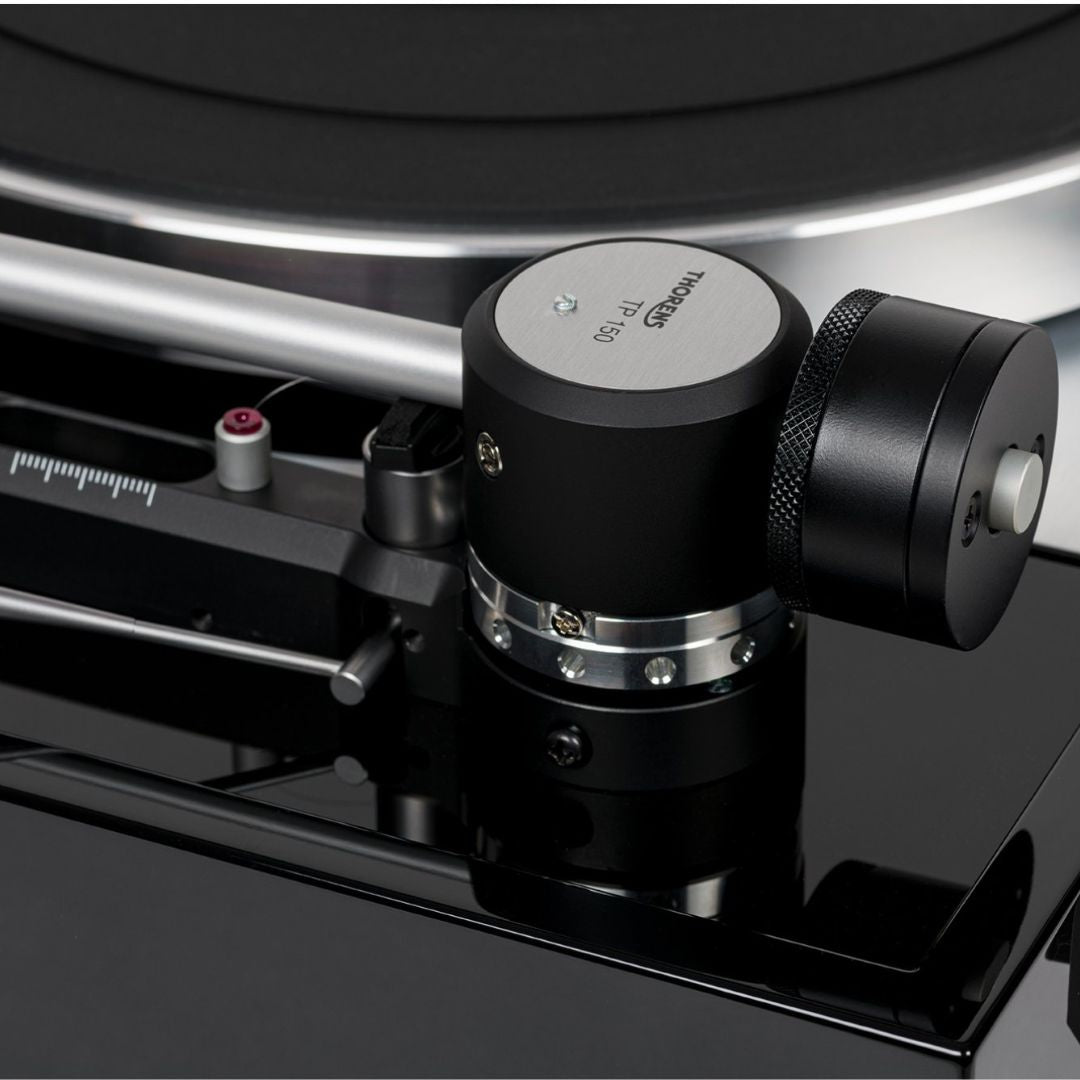
TP 150 tonearm
In 1965, Thorens introduced the TD 150, an unassuming turntable that sparked a technical revolution in turntable design. For the first time, a mass-produced turntable featured a suspended subchassis combined with an inner platter driven by a precision-ground flat belt. This innovative design principle went on to influence countless legendary Thorens turntables and remains a milestone in analogue audio engineering to this day.
An Idea That Nobody Has Improved On
In 1965 Thorens hung the platter and tonearm on three springs, isolated from the motor and the plinth, and mass-produced it. The TD 150 wasn't the first suspended subchassis design, but it was the first one ordinary people could buy — and half the audiophile turntables of the next thirty years were arguing with it.
The TD 1500 is the same idea, built now. Three conical springs carry a subchassis holding the platter, bearing, and tonearm, floating clear of the motor, the plinth, and whatever your room is doing. Motor vibration, footfall, bass from your speakers coming back through the shelf — all of it gets absorbed before it can reach the stylus. That's where the black backgrounds come from, and it's why a suspended deck can sit in the same room as a pair of floorstanders playing loud without feeding back.
Each spring works with a damping element. That detail matters more than it sounds like it should: an undamped spring stores energy and gives it straight back, the way a car with blown shocks keeps bouncing. The damping is what turns a spring into an isolator.
The subchassis is Alucobond — two aluminum skins bonded to a mineral core. Stiffer and deader than solid aluminum of the same weight, which is the whole reason to use a composite.
The practical upgrade over the original:
the springs adjust from above, through openings in the platter. On a TD 150, or a Linn, or most classic suspended decks, adjusting the suspension means taking things apart. On this one it's a few minutes with the platter in place. Anyone who has leveled a vintage suspended deck on a Saturday afternoon will understand why we keep mentioning it.
How a Belt Drive Solves Its Own Speed Problem
Belt drive has one honest weakness: the motor can only be as accurate as the loop connecting it to the platter.
Thorens' answer on the TD 1500 is an incremental encoder watching the DC motor and correcting it in real time. Put a record brush on a spinning platter and you've just added drag — that load travels back through the belt to the motor, the encoder registers the motor slowing, and the controller pushes back before you'd ever hear it. Lift the brush and it settles again. It's a closed loop, running constantly, and it's the reason a belt-driven deck at this price holds pitch as well as it does.
Operation is about as simple as turntables get. One lever on the left handles power and speed selection both, and that's the only control on the top plate. Thorens has never liked visible buttons and hasn't started now.
The 12V supply is external, which keeps AC-to-DC conversion — and its noise — outside the chassis entirely.
Why the Platter Is Lighter Than You'd Expect
The TD 1500's platter is 12-inch die-cast aluminum, 22mm thick, 1.4 kg. If you've been reading turntable marketing, that number will look modest. It's supposed to.
Platter mass on a suspended deck isn't a score to run up — it's a value the designer chooses, because the suspension is tuned around the weight it carries. Hang a 3.5 kg platter off three springs calibrated for 1.4 and you've broken the isolation that makes the deck worth owning. The mass is matched to the suspension, and the suspension is the entire point.
Within that budget, the rotating mass still does its job, resisting the small speed changes stylus drag creates as the groove content gets denser. It works with the encoder loop rather than substituting for it — mechanical inertia handling the fast stuff, electronic correction handling the rest.
The platter turns on a bearing with a Delrin thrust pad. Delrin is what you use when you want low friction, quiet running, and a part that outlives the person who bought it.
A heavy rubber mat sits on top.
The TP 150 Is the Part That Decides What You Can Own Later
Cartridges wear out. Tonearms don't. Whatever you put on this deck in year one, the arm is what determines your options in year six — which is why it's worth more attention than it usually gets.
The TP 150 is a nine-inch aluminum arm developed for the TD 1500, built on the same design principles as the TP 124 on Thorens' flagship TD 124 DD. Effective mass is 14 grams, which puts it squarely in medium territory: it'll partner happily with most moving magnets and a great many moving coils without the compliance mismatch that plagues arms at either extreme.
Adjustable where it counts. Height and azimuth both. VTA adjustment sets the pivot height so the arm sits level with cartridges of different body heights — swap from a tall MM to a squat MC and you can correct for it instead of living with it. Azimuth lets you square the stylus in the groove, which is what channel separation actually depends on.
The two-part counterweight is the flexibility story. Split it or don't, and the arm balances cartridges from roughly 6 to 30 grams. That's a genuinely wide window. Thorens' own product manager has confirmed the arm handles everything from 4-gram featherweights up to something as heavy as an Ortofon SPU — which is not a sentence you can write about most arms in this class.
SME bayonet headshell connector. The standard Ortofon/SME mount, which means you can keep two or three headshells with different cartridges pre-aligned and swap between them in about ten seconds. Mono cartridge for your jazz reissues, MC for everything else, no alignment protractor required after the first time.
Ruby-bearing anti-skate. A sliding weight in the arm base pulls on a nylon thread running over a ruby bearing. The ruby is there because friction at that contact point is the enemy — a sticky anti-skate mechanism applies uneven force across the record, which is worse than none at all. Ruby keeps it smooth and consistent from lead-in to run-out.
Balanced XLR and RCA — What Balanced Actually Buys You
Both output types are on the back panel, and the XLR pair is genuinely uncommon on a turntable at this price.
Here's the plain version of why it matters. A balanced connection sends your signal down two conductors carrying opposite polarity. Any noise the cable picks up along the way — hum from a nearby power cord, whatever your dimmer switch is doing — lands on both conductors identically, and the balanced input at the other end subtracts one from the other, cancelling the noise while the music survives intact.
That's useful with any cartridge and close to essential with a moving coil. MC output sits in the fractions-of-a-millivolt range, so the ratio of music to picked-up noise starts out far less favorable than with a moving magnet. Balanced operation claws that back. If your phono stage lives across the room from your turntable, you'll hear the difference more than someone with an 18-inch run.
RCA outputs are there for everyone running a conventional single-ended phono stage, which is most people, and there's nothing wrong with that.
One important warning from Thorens: don't run both output pairs at once. The manual is explicit that parallel operation isn't intended and can damage connected equipment. Pick one. If you're not sure which, ask us before you plug anything in.
No cables in the box, and that's on purpose. Thorens' position is that an entry-level interconnect isn't the right cable for a turntable at this level, and that they can't know whether you need RCA or XLR anyway — so they leave it to the dealer. We think that's the right call, and it means you'll need a tonearm cable terminated to match your phono stage before this deck plays a note. Tell us what you're running and we'll get you something appropriate at a price that makes sense. This is a five-minute conversation, not an upsell.
The Ortofon 2M Bronze — An Included Cartridge That Isn't a Placeholder
"Cartridge included" usually means a cartridge you'll replace within the year. Not this time.
The TD 1500 arrives with an Ortofon 2M Bronze mounted on the headshell and set up at the factory — tracking force and overhang already dialed in. It's the third step up Ortofon's 2M ladder and the point where the range stops being entry-level.
What the stylus does. The 2M Bronze uses a nude Fine Line diamond. Nude means the diamond is a solid piece bonded directly to the cantilever rather than a chip mounted on a metal shank — less mass at the business end, so the stylus follows groove detail more faithfully instead of lagging behind it. The Fine Line profile has a narrow, tall contact patch that reaches deeper into the groove wall and rides against more of it than an elliptical does. In practice: cleaner high frequencies, less mistracking distortion where the groove gets crowded near the label, and lower wear on your records because the contact pressure spreads over a larger area.
The numbers. Frequency response out to 29kHz. Channel separation better than 26dB at 1kHz. Output 5.5mV, which is healthy for a moving magnet and works with any MM phono input. Recommended tracking force 1.5g.
And when you're ready to move on, the arm is waiting for you. That two-part counterweight means the upgrade path runs all the way to heavy moving coils — Thorens' own TAS1500 MC was designed specifically for the TP 150 — without any need to change the arm or the deck. Buy this once and you're upgrading cartridges, not turntables.
Specifications
Core System
Operation: Manual with floating sub-chassis on three conical springs
Drive System: Belt drive with a polished precision belt
Motor: Electronically controlled and stabilized DC motor with an incremental encoder
Speeds: 33-1/3 RPM, 45 RPM (electronic switch)
Platter: 12-inch, 1.4 kg die-cast aluminum platter (22 mm thick)
Tonearm & Cartridge
Tonearm: Thorens TP 150 static-balance J-shaped arm (9-inch, 15 g effective mass) with SME-style headshell
Anti-Skating: Adjustable sliding weight on a nylon thread via a ruby bearing
Cartridge: Ortofon 2M Bronze moving-magnet (MM) cartridge with a nude Fine Line stylus
Dimensions & Weight
Dimensions (W x H x D): 420 x 150 x 360 mm
Weight: 7.9 kg
